






A buyer approves an LTL shipment based on a competitive quote. The pricing looks reasonable, the freight is booked, and everyone assumes the transportation cost is settled.
A week later, the invoice arrives. The linehaul charge matches the original quote, but several additional charges appear:
- Liftgate fee
- Residential surcharge
- Limited access fee
Suddenly, the total cost is hundreds of dollars higher than expected. The accounting team wants answers. Operations is reviewing shipment details and the carrier invoice.
In many cases, the issue is not that the carrier charged accessorials. Those charges often reflect legitimate services that were required to complete the pickup and delivery. The real issue is that the service requirements were not reported when the quote was requested, but after the shipment was completed.
LTL accessorial fees are a standard part of LTL transportation. Carriers use them to recover the additional labor, equipment, time, and coordination required for shipments that fall outside a basic dock-to-dock move. The key to controlling these charges is identifying them during the quoting process so costs are known upfront rather than discovered later on an invoice.
Understanding the LTL Accessorial Landscape
Many shippers encounter accessorials regularly but may not fully understand what each charge covers or why carriers assess them..
A LTL carrier’s standard pricing assumes freight will move between commercial locations that have loading docks, forklift access, and space to maneuver the necessary equipment. When a shipment requires additional handling or special pickup or delivery conditions, an accessorial charge will likely apply.
Some of the most common LTL accessorial fees include:
Liftgate Service
A liftgate fee applies when the carrier must use a truck-mounted hydraulic platform to raise or lower freight because a loading dock is unavailable or is of non-standard height.
Liftgate charges are common at:
- Small businesses
- Retail stores
- Residential locations
- Construction sites
- Storage facilities
Without advance notice, carriers may discover the need for a liftgate only after arriving at the pickup or delivery location.
Residential Delivery Charges
Residential deliveries require different routing, scheduling, and equipment planning than standard commercial deliveries. Even if the freight itself is simple to load or unload, carriers frequently assess residential surcharges due to the operational complexity of serving residential areas.
Limited Access Fees
A limited access fee is one of the most misunderstood accessorials in LTL shipping. Many facilities require additional coordination, security procedures, or specialized delivery processes that make them more difficult to service than a standard commercial dock.
Examples include:
- Schools
- Churches
- Farms
- Construction sites
- Military installations
- Government facilities
- Self-storage facilities
- Trade show venues
Because these locations often require extra time and planning, carriers typically classify them as limited-access destinations.
Appointment and Notification Charges
Some shippers and receivers require carriers to schedule appointments before pickup or delivery. Others require advance notification before carrier arrives. While these requirements may seem minor, they create additional administrative work and can affect route planning, resulting in additional fees.
Inside Delivery Charges
Standard LTL service generally ends at the curb or loading dock. When a driver is required to move freight inside a building, into a warehouse, or beyond the normal delivery point, inside delivery charges may apply.
Redelivery Charges
If a carrier arrives and cannot complete delivery because the receiver is unavailable, equipment is missing, or an appointment was not arranged, a redelivery charge may be assessed when the shipment must be delivered again.
These charges are not penalties. They are intended to cover real operational costs incurred by the carrier.
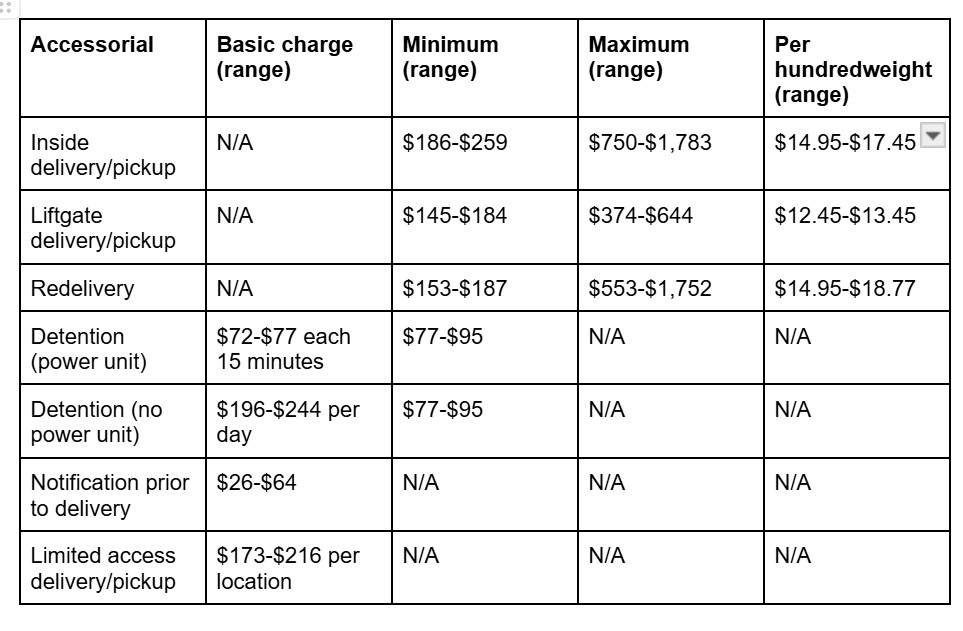
Here are some common fees and industry-average ranges (compiled from LTL carrier rate schedules):
Why Accessorial Fees Keep Appearing After the Fact
If accessorials are so common, why do they continue to surprise shippers? The answer usually comes down to incomplete shipment information during the quoting process.
Assumptions Made During Quoting
Many LTL shipments are initially quoted using only four pieces of information prior to July 2025. Since July 2025 unit dimensions are required as LTL pricing has moved to density based pricing. LTL quoting accuracy should also include the NMFC number and the Sub class if applicable:
- Pre-July 2025
- Origin ZIP code
- Destination ZIP code
- Weight
- Freight class
- Post-July 2025
- Origin ZIP code
- Destination ZIP code
- Weight
- Freight Class
- Unit Dimensions
- NMFC Code
- NMFC Sub Class
While those details are essential, they do not tell the entire operational story. Critical information is often omitted, including:
- Whether a dock is available; liftgate service required
- Whether a forklift is present
- Whether the receiver requires an appointment or delivery notification
- Whether the delivery location is a construction site or other limited access
Address Data Doesn’t Tell the Whole Story
Technology has improved address verification, but even sophisticated systems have limitations. Many shipping platforms can identify residential addresses. However, they often cannot reliably identify operational characteristics such as:
- Construction sites
- Schools
- Farms
- Churches
- Trade show venues
- Remote facilities
- Government buildings
A destination may appear to be a standard commercial address in a shipping system while still qualifying for a limited access fee. Without additional questioning, those charges may not become apparent until the shipment reaches the delivery location.
The Competitive Pricing Problem
There is also an industrywide pricing challenge that contributes to surprise invoices. Some providers focus heavily on generating the most competitive quote. If operational details are not disclosed upfront, the quote appears highly competitive.
Later, accessorials are added as they are discovered. The result is often:
- A lower initial quote
- A higher final invoice
- Frustrated customers
- Carrier integrity
- Billing disputes and increased back office costs
Accurate pricing is generally more valuable than artificially low pricing. Most shippers would rather know the true transportation cost before booking than discover additional charges after delivery.
The Intake Questions That Prevent Surprise Charges
The good news is that most accessorials can be identified before a shipment moves. A short intake conversation often uncovers the information necessary to build an accurate quote.
Questions That Catch Liftgate Fees
A liftgate fee can often be identified by asking a few simple questions:
- Is there a loading dock at pickup?
- Is there a loading dock at delivery?
- Will a forklift be available?
- Can the freight be loaded and unloaded without specialized equipment?
These questions frequently reveal liftgate requirements before dispatch.
Questions That Catch Limited Access Fees
Limited access charges are easier to identify when shippers ask whether the location is:
- A school
- A church
- A farm
- A construction site
- A military facility
- A storage facility
- A trade show venue
- A government building
Knowing the type of facility is often more important than simply knowing the street address.
Questions That Catch Appointment and Inside Delivery Charges
Additional questions should include:
- Does the receiver require a delivery appointment?
- Must the carrier provide advance notification?
- Will the freight remain at the curb or dock?
- Does the driver need to move freight inside the facility?
These details can significantly impact final costs.
Questions That Prevent Reclassification Charges
Accessorials are not the only source of invoice adjustments. Freight reclassification can also increase transportation costs if shipment information is inaccurate.
Before booking, shippers should confirm:
- Was the freight measured?
- Was the freight weighed?
- Are pallet counts accurate?
- Has the freight class/commodity been verified?
Accurate shipment data helps prevent unexpected billing corrections after carrier inspection.
The bottom line is simple: a five-minute intake conversation can prevent hundreds of dollars in invoice adjustments.
What ‘Ask at Quote’ Looks Like in Practice
Consider a common real-world scenario: A manufacturer distributes equipment through a Midwest distribution center and needs an LTL shipment delivered to a customer.
The initial quote request includes:
- Two pallets
- 1,200 pounds
- Freight class 85
- Pickup address
- Delivery address
At first glance, the shipment appears straightforward. However, a few additional questions reveal important details:
- The delivery location is an active construction site.
- There is no loading dock available.
- The contractor requires a scheduled delivery appointment.
- The freight will need liftgate service for unloading.
Now the shipment looks very different from the original request.
Without those questions, the shipment would likely move under an incomplete quote. The resulting invoice could include multiple additional charges after delivery. With those questions addressed upfront, the quote accurately reflects the shipment’s operational requirements.
Ensuring accurate service requirements are captured in the quoting process, the customer receives:
- Predictable transportation costs
- Fewer invoice disputes
- Reduced back office disruption
- Improved shipment planning
- Potential delivery delays and service disruptions
The shipment costs what everyone expected it to cost from the beginning.
A Quick LTL Accessorial Reference Card
Before every LTL tender, use the following checklist.
Pickup Location
- Dock available?
- Forklift available?
- Liftgate needed?
Delivery Location
- Residential address?
- Limited-access facility?
- Appointment required?
- Liftgate needed?
- Inside delivery needed?
Freight Information
- Accurate dimensions?
- Accurate weight?
- Correct freight class?
- Hazardous materials involved?
Special Handling Requirements
- Trade show delivery?
- Construction site?
- School?
- Church?
- Military base?
- Government facility?
If any of these boxes are checked, an accessorial discussion should occur before the quote is finalized.
How Wicker Park Logistics Helps Reduce Billing Surprises
At Wicker Park Logistics, our goal is not just securing transportation capacity, but understanding how a shipment will actually move before it is booked. That starts with operational discovery.
Rather than treating accessorials as after-the-fact exceptions, Wicker Park Logistics works to identify shipment requirements during the quoting process. Asking the right questions upfront uncovers liftgate requirements, appointment needs, limited-access locations, and other factors that may affect pricing.
This approach helps customers gain a more complete understanding of transportation costs before freight is tendered. The result is:
- More accurate quotes
- Fewer invoice surprises
- Reduced billing disputes
- Better budgeting accuracy
- Smoother shipment planning
For shippers managing frequent LTL transportation, that level of visibility can make a meaningful difference in both operational efficiency and cost control.
The Best Time to Discuss Accessorials Is Before the Shipment Moves
LTL accessorial fees are not unusual, and they are not necessarily avoidable. Liftgate fees, residential delivery charges, limited access fees, appointment requirements, and other accessorials all reflect real services performed by carriers.
What creates frustration is not the existence of these charges. It is discovering them after the shipment has already moved. The most effective way to control LTL shipping costs is not to eliminate accessorials. It is to identify them during the quoting process so the final invoice aligns with expectations.
When operational requirements are discussed upfront, shippers gain clearer visibility into costs, carriers can plan deliveries more effectively, and transportation budgets become more predictable.
At Wicker Park Logistics, we ask the operational questions before the shipment moves so your quote reflects the reality of the delivery. The result is fewer surprises, more accurate budgeting, and smoother LTL planning and execution from pickup through final delivery.
To learn more about Wicker Park Logistics’ LTL transportation solutions, contact our team and get a quick quote today.


